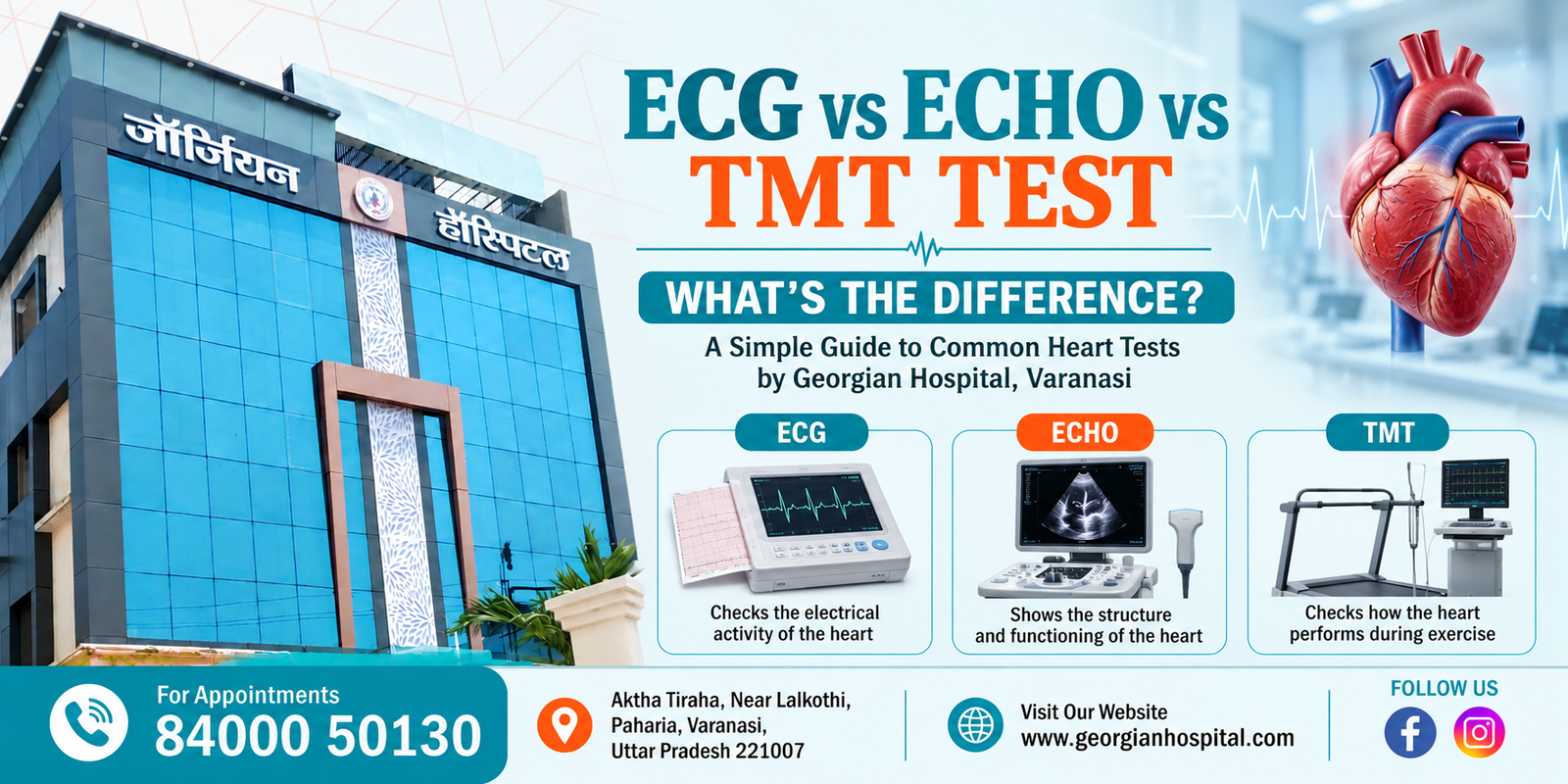
ECG, Echo, TMT Test — Kaunsa Karana Hai? A Simple Guide to Heart Investigations
This article is for general health education only and is not a substitute for professional medical advice. Always consult a qualified healthcare professional for diagnosis and treatment.
Quick Answer: What Is the Difference Between ECG, Echo, and TMT?
An ECG (electrocardiogram) records the heart’s electrical activity to assess rate and rhythm. An Echo (echocardiography) uses ultrasound to produce images of the heart’s structure and function. A TMT (treadmill test) monitors how the heart responds during physical exercise. Each test serves a different purpose, and a doctor decides which one — or which combination — is appropriate based on the individual patient.
Introduction: Why Doctors May Recommend Heart Tests
When a patient visits a doctor with symptoms such as chest discomfort, unexplained breathlessness, palpitations, or fatigue, the doctor may recommend one or more investigations to better understand what is happening with the heart.
Three of the most commonly discussed cardiac investigations in India are the ECG, the Echo, and the TMT. Many patients are unsure which test does what — and sometimes worry unnecessarily about what a recommendation means.
This guide explains each test in plain language so that patients and families can have more informed conversations with their doctors.
Important: If you experience sudden or severe chest pain or pressure, difficulty breathing, fainting, or rapid or irregular heartbeat that is new and concerning, please seek emergency medical care immediately. Do not wait to book a routine test.
What Is an ECG Test?
An electrocardiogram (ECG) is a non-invasive test that records the electrical signals produced by the heart with each beat. Small electrodes are attached to the skin of the chest, arms, and legs, and the machine produces a printed tracing.
An ECG can help a doctor assess:
- Heart rate (how fast the heart is beating)
- Heart rhythm (whether it is regular or irregular)
- Certain electrical conduction patterns
An ECG is typically quick — it usually takes a few minutes — and does not involve radiation or injections.
What an ECG cannot tell you: A normal ECG does not rule out all heart problems. Some conditions may not produce any changes on a resting ECG. Your doctor will interpret the result alongside your symptoms and clinical examination.
What Is an Echo Test?
An echocardiogram (Echo) uses ultrasound waves to create real-time images of the heart. A device called a transducer is moved across the chest, and the returning sound waves produce a moving picture of the heart on a screen.
An Echo can help a doctor assess:
- The size and shape of the heart’s chambers
- How well the heart muscle is pumping
- The structure and function of the heart valves
- Whether fluid is present around the heart
An Echo does not involve radiation. It is generally painless, though the transducer may be pressed firmly against the chest.
What an Echo cannot tell you: Echocardiography provides structural and functional information. It does not directly assess the coronary arteries (the blood vessels that supply the heart muscle). Additional investigations may be needed depending on the clinical situation.
What Is a TMT Test?
A treadmill test (TMT), also called a cardiac stress test or exercise electrocardiography, records the heart’s electrical activity while a patient walks on a treadmill at gradually increasing speeds and inclines. It monitors how the heart responds when it is working harder than at rest.
A TMT can help a doctor assess:
- How the heart responds to physical exertion
- Certain changes in heart rhythm or electrical activity that appear only during exercise
- Exercise capacity
Important: TMT is not suitable for every patient. The doctor will assess whether it is appropriate based on the patient’s age, symptoms, general health, and other factors before recommending it. Patients with certain conditions may not be candidates for this test.
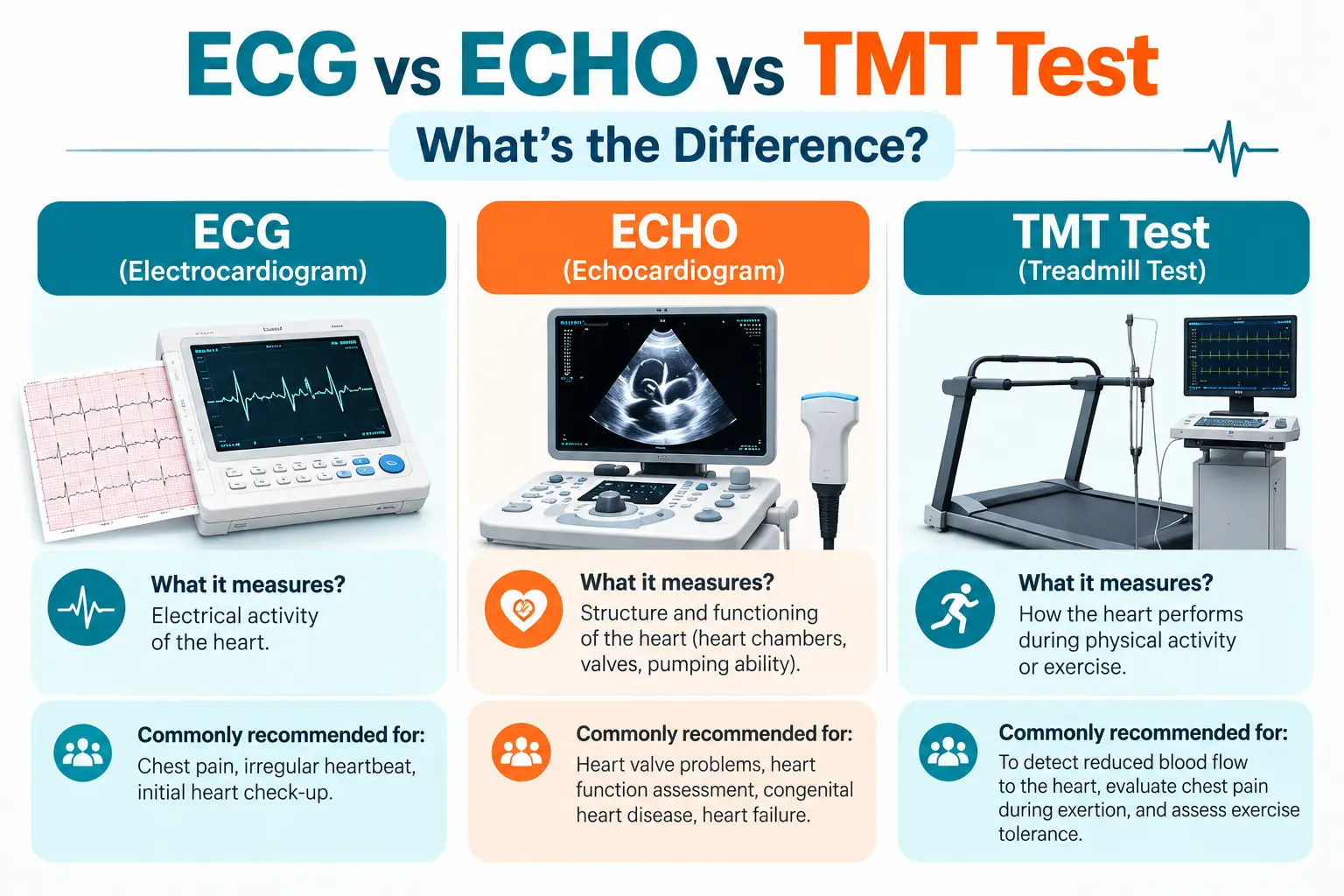
ECG vs Echo vs TMT: A Simple Comparison
| Feature | ECG | Echo | TMT |
| What it measures | Electrical activity of the heart | Structure and function using ultrasound | Heart’s electrical response during exercise |
| How it works | Electrodes on skin record signals | Ultrasound probe placed on chest | Patient walks on treadmill while ECG is monitored |
| Duration | 5–10 minutes | 20–45 minutes | 30–60 minutes (varies) |
| Radiation involved | No | No | No |
| Useful for assessing | Rate, rhythm, conduction | Valve function, pumping, structure | Response to exertion, exercise-induced changes |
| Requires exercise | No | No | Yes |
| Suitable for all patients | Generally yes | Generally yes | Requires clinical assessment |
This table is for general reference only. Your doctor will determine which investigation is appropriate for you.
Which Test Might a Doctor Recommend?
There is no single rule. A doctor decides based on the patient’s specific symptoms, medical history, physical examination findings, and clinical judgement.
As general examples:
- A doctor may start with an ECG for a patient presenting with palpitations or an irregular pulse.
- An Echo may be recommended when a doctor wants to assess the heart’s pumping function or evaluate the heart valves.
- A TMT may be considered when symptoms occur specifically during or after physical activity and the doctor wants to evaluate the heart under exertion — provided the patient is a suitable candidate.
In many cases, more than one test may be recommended. The results are always interpreted together with the patient’s overall clinical picture.
How Should Patients Prepare?
Preparation varies depending on the test and the facility.
For an ECG: No special preparation is usually needed. Inform the technician about any patches, skin conditions, or implanted devices.
For an Echo: Your doctor or the testing centre will provide specific instructions. Loose, comfortable clothing makes the test easier.
For a TMT: You may be asked to avoid eating for a few hours beforehand, wear comfortable shoes, and avoid heavy exercise on the day of the test. Do not stop or change any prescribed cardiac medication without first consulting your doctor. The testing centre will give you detailed instructions.
Always follow the guidance given by your doctor and the facility where the test will be performed.
Are These Three Tests Enough to Diagnose All Heart Conditions?
No single test can detect every heart condition. The ECG, Echo, and TMT each provide different information, and in some cases additional investigations — such as blood tests, a Holter monitor, CT coronary angiography, or other specialist assessments — may be needed.
Your doctor will determine the appropriate next steps based on the test results and your clinical situation.
When to Seek Emergency Care
Do not delay emergency care if you experience:
- Sudden, severe, or persistent chest pain or pressure
- Pain spreading to the arm, jaw, neck, or back
- Severe difficulty breathing
- Sudden loss of consciousness or fainting
- Rapid or very irregular heartbeat with dizziness
These symptoms may require immediate assessment. Please go to the nearest emergency department or call for emergency help.
Heart Investigation at Georgian Hospital, Varanasi
Georgian Hospital, located at Aktha Tiraha, Near Lalkothi, Paharia, Varanasi – 221007, provides multispeciality medical services including general medicine and cardiology consultation for patients across Varanasi and surrounding areas.
If you have concerns about your heart health or have been advised to undergo cardiac investigations, speaking with a qualified doctor is the right first step. Georgian Hospital is available 24×7 for emergency care and routine consultations.
📞 +91 84000 50130 | 🌐 georgianhospital.com
Please confirm specific test availability directly with the hospital team before your visit.
Frequently Asked Questions
What is the difference between ECG, Echo, and TMT?
An ECG records the heart’s electrical activity. An Echo uses ultrasound to produce images of the heart’s structure and how well it pumps. A TMT monitors the heart’s electrical response during exercise. Each test provides different information, and a doctor decides which is appropriate based on the individual patient’s symptoms and clinical assessment.
Is an ECG enough to diagnose a heart problem?
An ECG provides useful information about rate, rhythm, and certain electrical patterns, but it cannot detect every type of heart problem. A normal ECG does not rule out all cardiac conditions. Your doctor will decide if further investigations are needed based on your symptoms and clinical examination.
Is an Echo test painful?
An echocardiogram is generally painless. The transducer may be pressed firmly against the chest to obtain clear images, which some people find mildly uncomfortable, but there is no injection or radiation involved.
Who should not undergo a TMT test?
A treadmill test is not suitable for everyone. Patients with certain heart conditions, very high blood pressure, severe joint problems, or other specific health conditions may not be appropriate candidates. A doctor will assess suitability before recommending a TMT.
Can a normal Echo mean the heart is completely healthy?
A normal echocardiogram means that the heart’s structure and pumping function appear normal on ultrasound at the time of the test. It does not assess the coronary arteries directly and does not rule out all cardiac problems. Your doctor will review the result alongside your other investigations and clinical assessment.
Do I need to stop my heart medication before a TMT?
Do not stop or change any prescribed medication without your doctor’s advice. Some medications may be adjusted before certain cardiac investigations, but only under medical supervision. Always ask your doctor or the testing facility for specific guidance before the test.
Where can I get an ECG or Echo test in Varanasi?
Cardiac investigations including ECG are available at several hospitals and diagnostic centres in Varanasi. Georgian Hospital, Paharia, offers cardiology services and general medicine consultations. Contact the hospital directly at +91 84000 50130 or visit georgianhospital.com to confirm current availability.
Conclusion
ECG, echocardiography, and the treadmill test are three commonly used cardiac investigations, each measuring something different about the heart. No single test tells the complete story, and each serves a specific purpose in the hands of a trained clinician.
If you have been advised to undergo any of these tests — or if you have ongoing concerns about your heart health — the most important step is to speak with a qualified doctor who can assess your situation properly and guide you accordingly.
For consultations and emergency care in Varanasi, Georgian Hospital at Paharia is available 24×7. Call +91 84000 50130 or visit georgianhospital.com.
Stay Connected with Georgian Hospital
Stay informed about your health. Follow Georgian Hospital on social media for heart health awareness, doctor education videos, and patient-friendly health tips:
📘 Facebook — Healthcare updates and awareness posts
📸 Instagram — Health tips and hospital updates
▶️ YouTube — Expert videos on cardiology, neurology, orthopaedics, and more
📞 For appointments and enquiries: +91 84000 50130
Share this article with someone who needs a clearer understanding of heart tests.