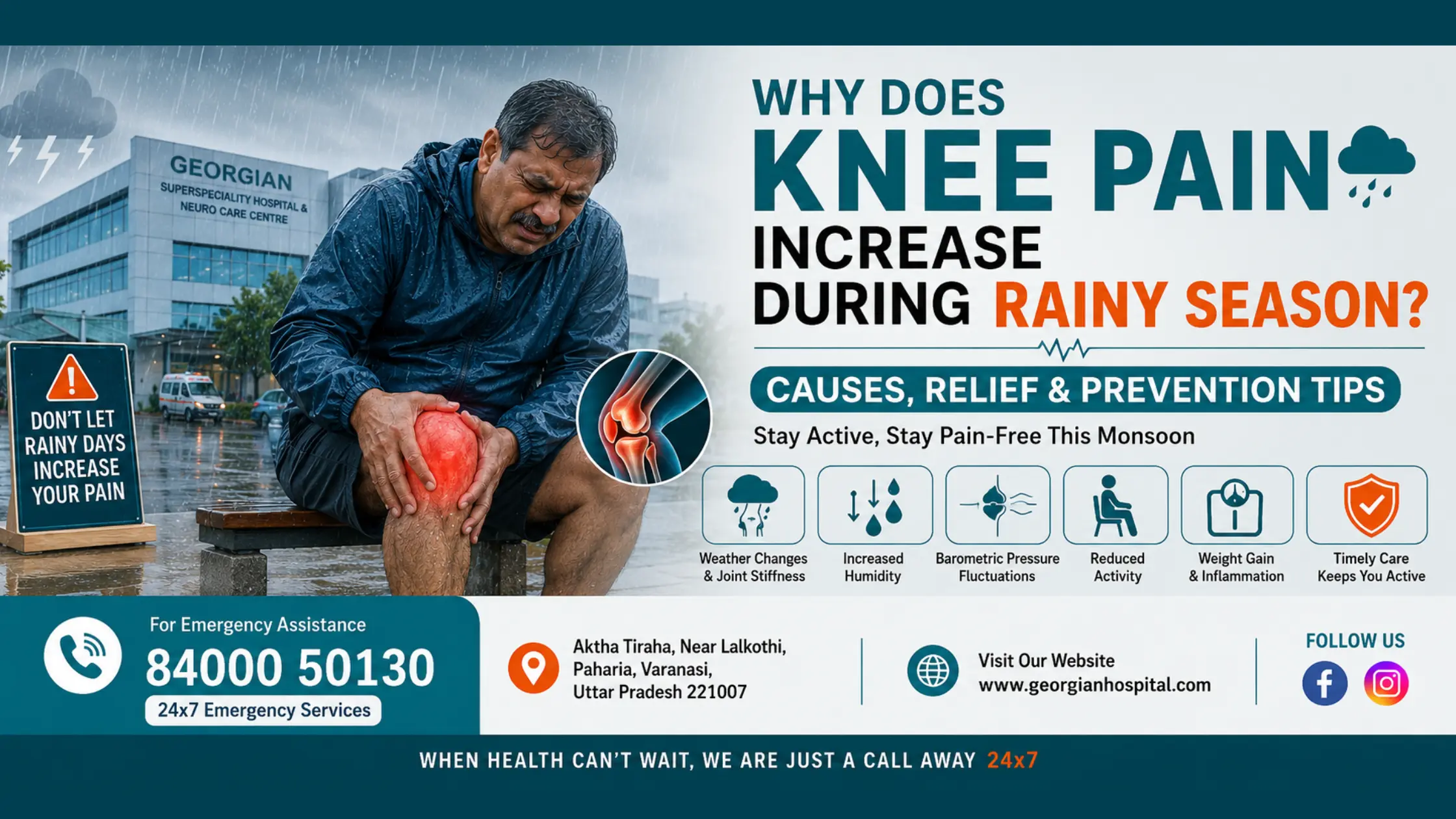
Why Does Knee Pain Increase During Rainy Season?
Content reviewed by Dr. Ajeet Singh, MS (Orthopaedics), DNB, FICS — Orthopedic Surgeon, Georgian Hospital, Paharia, Varanasi.
Introduction
Every year, as the monsoon arrives in Varanasi, orthopedic clinics see a noticeable rise in patients complaining of knee pain, joint stiffness, and worsening arthritis symptoms. Many people assume it is just a coincidence. It is not.
There are real, well-documented physiological reasons why knee pain — especially arthritis-related knee pain — tends to flare up during the rainy season. Understanding why this happens helps you manage it better and know when it is time to see a doctor.
This guide covers the science behind monsoon knee pain, what you can do at home, and when professional evaluation becomes necessary.
Quick Answer
Knee pain often increases during the rainy season because of a drop in barometric (atmospheric) pressure, which causes the tissues inside the joint to expand slightly — putting added pressure on already sensitive or inflamed joints. Higher humidity also affects muscle and ligament flexibility, while cold, damp conditions reduce blood circulation to joint areas, increasing stiffness and pain perception.
The Science Behind Monsoon Knee Pain
What Is Barometric Pressure and Why Does It Affect Joints?
Barometric pressure is the weight of the atmosphere pressing down on the earth’s surface. Before and during rainfall, this pressure drops.
Inside your knee joint, there is fluid, cartilage, and synovial tissue — all of which respond to pressure changes. When atmospheric pressure drops, the tissues inside the joint can expand slightly. For a healthy knee, this is barely noticeable. But for a joint already affected by arthritis, cartilage wear, or inflammation, even minor swelling creates noticeable pain and stiffness.
This is not a myth. Research published in medical literature has shown a consistent link between falling barometric pressure and increased joint pain reports among arthritis patients.
How Humidity Makes It Worse
High humidity — which peaks during the monsoon in Varanasi — affects the muscles and soft tissues surrounding the knee. Moisture in the air reduces the body’s ability to evaporate sweat efficiently, which can subtly affect muscle flexibility and increase the sense of heaviness and stiffness in the joints.
Combined with reduced physical activity during rains (people move less, sit more), this creates the perfect condition for joint stiffness to build up.
Reduced Sunlight and Vitamin D Deficiency
Monsoon clouds block sunlight for weeks at a time. Since sunlight is the body’s primary source of Vitamin D — a nutrient essential for bone density and joint health — prolonged cloudy weather can worsen underlying bone and joint conditions over time.
Vitamin D deficiency is already very common in India, and the monsoon months tend to deepen this gap, particularly for people who spend most of their time indoors. Learn more about Vitamin D and bone health from the WHO.
Cold and Dampness Reduce Circulation
Cooler temperatures during the rainy season cause blood vessels to constrict slightly, reducing blood flow to peripheral areas — including the knees. Less blood flow means less warmth in the joint, slower delivery of nutrients to cartilage, and slower removal of inflammatory waste products.
This is why people often describe a deep, aching pain in their knees during monsoon — rather than a sharp pain. It is the joint responding to circulatory slowdown and tissue expansion simultaneously.
Who Is Most Affected by Knee Pain During Monsoon?
Monsoon-related knee pain affects a wide range of people, but certain groups experience it more severely:
- Osteoarthritis patients — the most commonly affected group; worn cartilage is highly sensitive to pressure and temperature changes
- Rheumatoid arthritis patients — immune-mediated inflammation tends to flare during damp, cold conditions
- People over 45 — natural cartilage thinning makes joints more pressure-sensitive
- Women post-menopause — hormonal changes reduce bone density and joint protection
- Overweight individuals — excess body weight multiplies the pressure on knee joints
- People with previous knee injuries — old ACL tears, meniscus damage, or fractures leave joints more reactive to weather changes
- Those with sedentary lifestyles — reduced muscle support around the knee worsens joint loading
Symptoms to Watch During Rainy Season
Monsoon knee pain often presents differently from the sharp pain of an injury. Common symptoms include:
- Dull, aching pain that worsens in the morning or after sitting for long periods
- Increased stiffness when getting up, especially after rain or on overcast days
- Swelling around the knee joint
- A grinding or clicking sensation when bending the knee
- Difficulty climbing stairs or walking on uneven ground
- Warmth or redness around the joint (suggests active inflammation)
If you have been managing knee pain and notice a clear worsening pattern during monsoon, it is worth tracking whether it correlates with rainy days — many patients are surprised to find the link is very consistent.
For a broader understanding of joint pain patterns, our guide on joint pain doctor in Varanasi covers the full spectrum of causes and when to seek specialist care.
Home Management Tips for Monsoon Knee Pain
While you should not self-treat a serious joint condition, there are evidence-based measures that help manage seasonal flare-ups:
Keep moving — gently Reduced activity makes stiffness worse. Gentle indoor exercises — leg raises, seated knee extensions, gentle cycling on a stationary bike — maintain circulation and muscle support around the knee. Our guide on knee pain relief tips by Dr. Ajeet Singh has specific exercises you can do at home.
Warmth helps Apply a warm compress or heating pad to the knee for 15–20 minutes. Warmth improves local circulation and relaxes the surrounding muscles. Avoid applying heat if there is active swelling or redness — use a cold pack in that case.
Check your Vitamin D If you haven’t had your Vitamin D levels checked recently, monsoon is a good time to do so. Low levels are easy to correct with supplements under medical guidance. Dr. Ajeet Singh’s blog on strong bones tips covers the role of nutrition in bone and joint health.
Maintain a healthy weight Every additional kilogram of body weight adds approximately 3–4 kg of force on the knee during walking. Weight management is one of the most impactful long-term strategies for arthritis knee pain.
Footwear matters Monsoon makes floors slippery. Wear non-slip footwear indoors and outdoors to avoid falls — especially important for elderly patients with existing knee problems.
When Should You See a Doctor for Monsoon Knee Pain?
Routine Consultation — Book an Appointment
- Knee pain that worsens every monsoon season and disrupts daily activities
- Stiffness lasting more than 30 minutes in the morning
- Swelling that comes and goes without injury
- Pain that is not relieved by rest or a warm compress
- Difficulty walking normally on rainy days
Prompt Evaluation — See a Doctor Soon
- New swelling with warmth and redness
- Pain severe enough to prevent weight-bearing
- Clicking or locking of the knee joint
- Progressive worsening of pain over 2–3 weeks despite rest
Emergency — Go Immediately
- Sudden severe pain after a fall or twist
- Knee unable to bear any weight
- Visible deformity of the knee
- Fever along with joint pain and swelling (possible infection)
For trauma-related knee injuries during monsoon, Georgian Hospital’s 24×7 emergency and trauma care is available at Paharia, Varanasi.
Expert Orthopedic Care at Georgian Hospital, Paharia, Varanasi
For patients in Varanasi experiencing monsoon knee pain — particularly those with arthritis, old injuries, or progressive joint problems — Georgian Hospital’s Orthopaedics department offers structured evaluation and treatment.
Dr. Ajeet Singh — MS (Orthopaedics), DNB, FICS, FIFA Diploma in Football Medicine — leads the department. He trained at Ram Manohar Lohia Hospital New Delhi, Lady Hardinge Medical College, and Carl Gustav Carus University, Germany, and has managed a wide range of knee conditions from early arthritis to complex joint reconstruction.
The evaluation typically includes:
- Clinical assessment of knee joint mobility, stability, and pain pattern
- On-site X-ray to assess joint space and bone health
- Ultrasound where soft tissue assessment is needed
- Individualized treatment planning — from physiotherapy and anti-inflammatory management to surgical options where required
For patients whose pain has progressed to the point where conservative management is insufficient, joint replacement in Varanasi is also available at Georgian Hospital.
Dr. Ajeet Singh’s OPD: 9:00 AM – 11:30 AM
Georgian Hospital, Akatha Tiraha, Near Lalkothi, Paharia, Varanasi – 221007
📞 +91 84000 50130
Frequently Asked Questions
Q1. Why does my knee pain get worse every rainy season?
Falling barometric pressure during monsoon causes joint tissues to expand, increasing pressure inside already sensitive or arthritic knees. High humidity reduces muscle flexibility, and cooler temperatures slow blood circulation to the joint — all of which combine to worsen pain. If this happens regularly every monsoon, a formal evaluation by an orthopedic doctor is advisable.
Q2. Is monsoon knee pain a sign of arthritis?
It can be. Weather sensitivity is common in osteoarthritis and rheumatoid arthritis, as damaged or inflamed joints respond more noticeably to pressure and temperature changes than healthy joints. However, not all monsoon knee pain means arthritis — a proper diagnosis from an orthopedic specialist is needed to confirm the cause.
Q3. Can I exercise during monsoon if I have knee pain?
Yes — gentle, low-impact exercise is beneficial. Indoor exercises like leg raises, gentle stretches, and seated knee extensions help maintain muscle support and circulation. Avoid high-impact activities or exercises that cause pain. Consult Dr. Ajeet Singh at Georgian Hospital for an exercise plan suited to your specific condition.
Q4. What is the best home remedy for knee pain during rainy season?
Warm compresses, gentle movement, and anti-inflammatory dietary choices (turmeric, omega-3-rich foods) can provide some relief. However, home remedies only address symptoms — they do not treat the underlying condition. If pain is recurrent or worsening, professional evaluation is recommended rather than relying solely on home management.
Q5. Does Vitamin D deficiency cause more knee pain in monsoon?
Yes. Monsoon reduces sunlight exposure, which reduces the body’s natural Vitamin D production. Low Vitamin D weakens bones and impairs joint health, potentially worsening pain in susceptible individuals. A simple blood test can check your Vitamin D levels, and supplementation can be prescribed by your doctor if needed.
Q6. Which doctor should I consult for knee pain in Varanasi?
An orthopedic surgeon or bone and joint specialist is the appropriate specialist for knee pain evaluation. In Varanasi, Dr. Ajeet Singh at Georgian Hospital, Paharia, offers OPD consultations from 9:00 AM to 11:30 AM. For appointments, call +91 84000 50130.
Q7. Is knee pain in rainy season different from winter knee pain?
The mechanisms overlap but differ slightly. Rainy season pain is driven primarily by falling barometric pressure and high humidity. Winter knee pain is more directly caused by cold-induced muscle stiffness and reduced circulation. Both can worsen arthritis symptoms, but the seasonal triggers are distinct.
Q8. When does monsoon knee pain require surgery?
Most monsoon-related knee flare-ups do not require surgery. Surgery is considered when the underlying joint condition — typically severe arthritis — has reached a stage where conservative management no longer provides adequate relief. An X-ray and clinical assessment by an orthopedic specialist will determine whether surgical options like joint replacement are appropriate. Read our complete guide on joint replacement in Varanasi for more information.
Q9. Can early signs of bone problems cause monsoon knee pain?
Yes. Underlying bone density issues or early degeneration — which may not cause symptoms on ordinary days — can become noticeable under the additional joint stress of monsoon conditions. Recognizing early signs of bone problems and getting a timely evaluation prevents minor issues from becoming major ones.
Q10. How do I book an appointment at Georgian Hospital for knee pain?
Call +91 84000 50130 or visit georgianhospital.com/appointment/ to book a consultation with Dr. Ajeet Singh. Walk-in OPD is also available at Georgian Hospital, Akatha Tiraha, Near Lalkothi, Paharia, Varanasi – 221007, between 9:00 AM and 11:30 AM.
Stay Connected with Georgian Hospital
Health awareness should not stop at the clinic door. Georgian Hospital regularly shares expert health content to help families in Varanasi make informed decisions year-round.
Follow us for seasonal health alerts, doctor awareness videos, joint and bone care tips, monsoon health guidance, health camp announcements, and hospital updates:
📘 Facebook: facebook.com/georgianhospitalvns
📸 Instagram: instagram.com/georgianhospitalvns
▶️ YouTube: youtube.com/@GeorgianHospital
If this article helped you, share it with someone in your family who deals with knee pain every monsoon. Early awareness leads to earlier, simpler treatment.
📞 For appointments: +91 84000 50130
Conclusion
Knee pain during rainy season is not random — it has clear physiological causes rooted in pressure changes, humidity, reduced circulation, and Vitamin D depletion. For people with existing arthritis or joint problems, the monsoon can turn manageable pain into something that genuinely disrupts daily life.
The right response is not to wait it out every year. A proper evaluation by an orthopedic doctor in Varanasi helps identify the underlying condition, create a management plan, and prevent gradual worsening season after season.
Dr. Ajeet Singh and the orthopaedics team at Georgian Hospital, Paharia, are available for consultations. Call +91 84000 50130 or visit georgianhospital.com to book your appointment.
This article why does knee pain increase during rainy season is written for informational and awareness purposes only. It does not replace professional medical advice, diagnosis, or treatment. Always consult a qualified orthopedic specialist for evaluation of knee pain or joint conditions. Content produced for Georgian Hospital, Paharia, Varanasi.